
What if damage increases value?
A headless Artemisia Gentileschi and what we really mean by contemporary art

In the art market, damage is, by definition, a loss of value.
An incomplete work is a compromised work, something to be restored, concealed, or in the worst case discarded. And yet, in two days, a painting will go under the hammer at Dorotheum in Vienna that seems to work in exactly the opposite way.
It is a Mary Magdalene by Artemisia Gentileschi, estimated between 100,000 and 150,000 euros. The work, now fragmentary, spent many years in a private collection in Germany, where it lay rolled up in a basement. At some unspecified point, most likely during the chaos and looting of postwar Berlin, the saint’s head was cut from the canvas, leaving the painting mutilated in its most significant part.
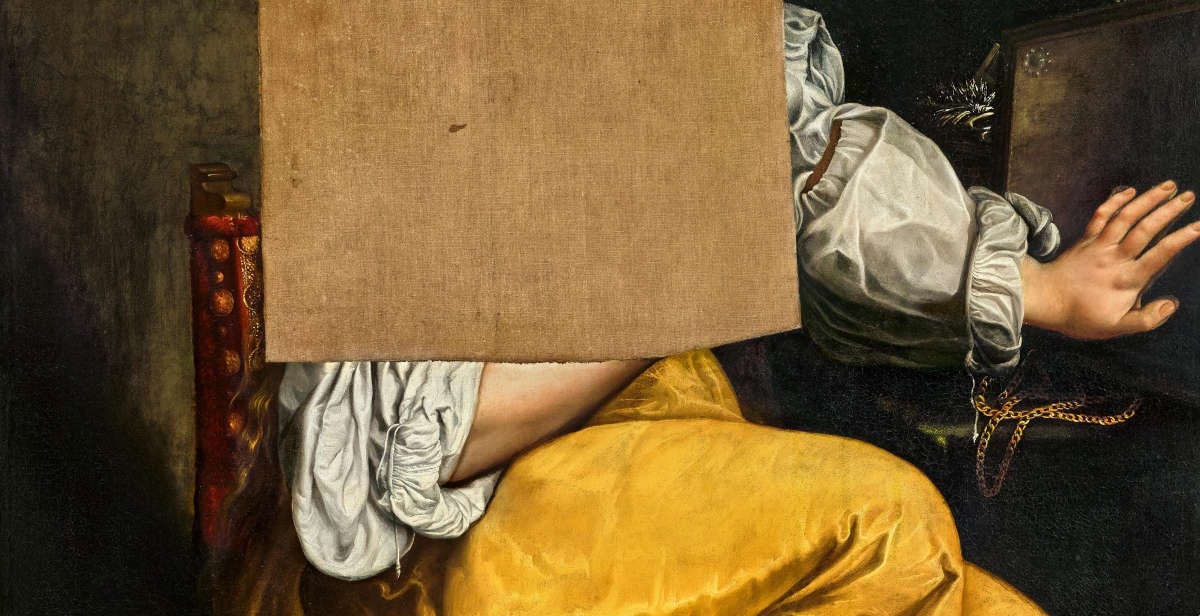
Despite this radical loss, the quality of the work was recognized, carefully restored, and preserved by its current owner. The painting still carries that presence and authority that define Artemisia Gentileschi’s work.
The work was brought back to scholarly attention in 2011 by Roberto Contini, who identified it as an autograph replica of the Mary Magdalene held at the Galleria Palatina in Palazzo Pitti, Florence, with which it shares almost identical dimensions.
The peculiarity, however, remains as striking as it is unsettling: the painting is missing its face. Not a marginal portion, but the very center of the composition, the point where expression normally concentrates, and where the relationship with the viewer is formed.
And it is precisely this absence that makes it surprisingly contemporary.
We tend to think of contemporary art as a chronological matter, something that concerns the present and living artists. But this definition is, at its core, fragile. The contemporary is not merely a temporal category: it is a condition of the gaze - the moment when a work, however distant in time, ceases to belong exclusively to history and begins once again to produce experience in the present.
This Magdalene carries with it a real wound that today translates into an unexpected form of intensity. The void left by the missing face is not simply an absence: it becomes a surface of projection, a space that asks to be filled by the viewer’s gaze.
In the language of the market, damage should reduce value. Here, paradoxically, it transforms it. The work loses none of its historical relevance, Artemisia Gentileschi remains one of the most extraordinary figures of the Baroque, capable of asserting herself within a deeply male-dominated system and building an independent career until she became the first woman admitted to the Accademia di Firenze in 1616. That loss instead introduces a dimension we recognize as profoundly contemporary.
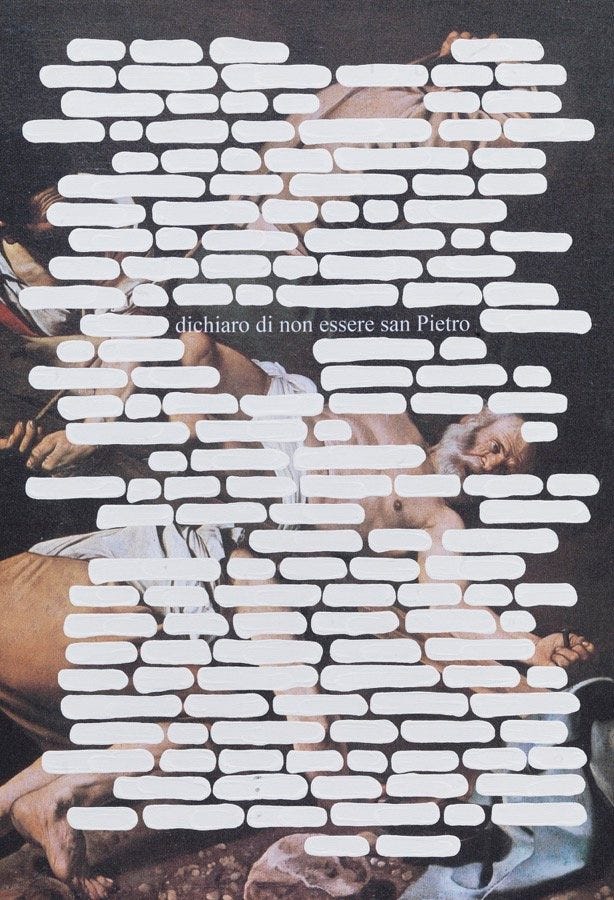
Art historian Riccardo Lattuada has suggested a parallel with the work of Emilio Isgrò, in whose pieces erasure does not represent a subtraction but a generative act. To eliminate, in this context, is to produce new meaning.
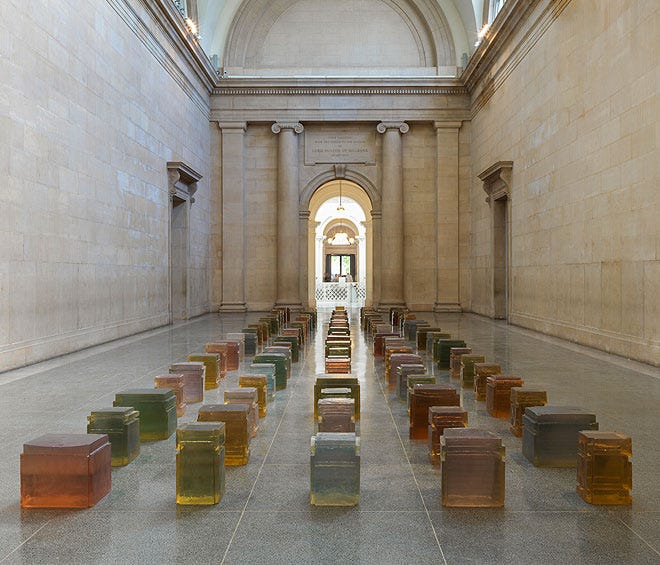
In a similar way, in the work of Rachel Whiteread or in the installations of Edmund de Waal, void and negative space are not secondary elements but load-bearing structures through which presence and loss are simultaneously articulated.
Thirty spokes share the wheel’s hub; it is the center hole that makes it useful.
Shape clay into a vessel; it is the space within that makes it useful.
Cut doors and windows for a room; it is the holes which make it useful.
Therefore profit comes from what is there; usefulness from what is not there.
Laozi
In this sense, the mutilated Magdalene no longer appears merely as a damaged seventeenth-century work, but as an object that activates perceptual and conceptual dynamics of remarkable currency. The absent face interrupts the traditional reading and demands a different relationship, more unstable, less mediated, in which the viewer is called to confront what is missing as much as what remains.
And perhaps it is here that a broader question emerges, one that concerns not only art history but the market itself: what are we really buying when we acquire a work of art?
Its material integrity, the name of its creator or its capacity to generate a meaningful experience in the present?
This Magdalene, incomplete, marked by time and violence, seems to suggest that value does not reside exclusively in preservation, but in its continuous transformation. Not only in what the work once was, but in what it continues to be for those who encounter it today.
In this sense, the contemporary does not necessarily coincide with the moment a work was made, but with its ability to remain active, to keep producing meaning, even through loss. And sometimes, it is precisely what is missing that brings it closest to us.
Greta Zuccali
Inspiration
John Gerrard, Standard (formerly Surrender Flag), 2023

In his work, John Gerrard transforms smoke, fire and vapor into symbols of our time: the energy that has shaped the contemporary world, and the one we will inevitably have to reckon with. Through real-time digital simulations, he renders visible infrastructures and processes that usually remain hidden, slowing them down until they become contemplative images.
Events of the month
Corals Gallery Milan
Last week to visit “Contemporary Bodies: Between Image and Imagination”. The show brings together Hyun Cho and Manuel Castillo in a conversation about what it means to inhabit a body today, between ancient, archetypal imagery and the quiet strangeness of digital intimacy.
On view until April 30 at Galleria Corals, Milan. Monday to Friday, 3–7 pm. Part of the official program of Milano Art Week.
To learn more about my work, discuss collaborations, share event news, or suggest exhibitions for review, get in touch at hello@hub-art.org.